Mentored the product team through strategy and architecture at formative stages, then stepped in to design the bank reconciliation workflow directly — for GMB, a SaaS POS platform for French entrepreneurs later acquired by CEGID.
- Mentorship
- Product Design
01 · Context
Accounting depth, entrepreneurial users.
Making complex financial workflows accessible to non-accountants without oversimplifying the accounting logic underneath.
French entrepreneurs running small businesses need to manage sales, stock, invoicing, and bank reconciliation — but most have no background in accounting software. GMB was later acquired by CEGID and integrated into their enterprise offering.
The mentorship question:
Guide the architecture early; design the hardest flow directly. Leverage where it compounds.
How do you shape a product's direction during its formative stages — when decisions are still cheap to change but will be expensive to undo later?
02 · Key decisions
Decisions that made accounting legible to non-accountants.
Shape the architecture while it's still cheap
Product direction and architecture.
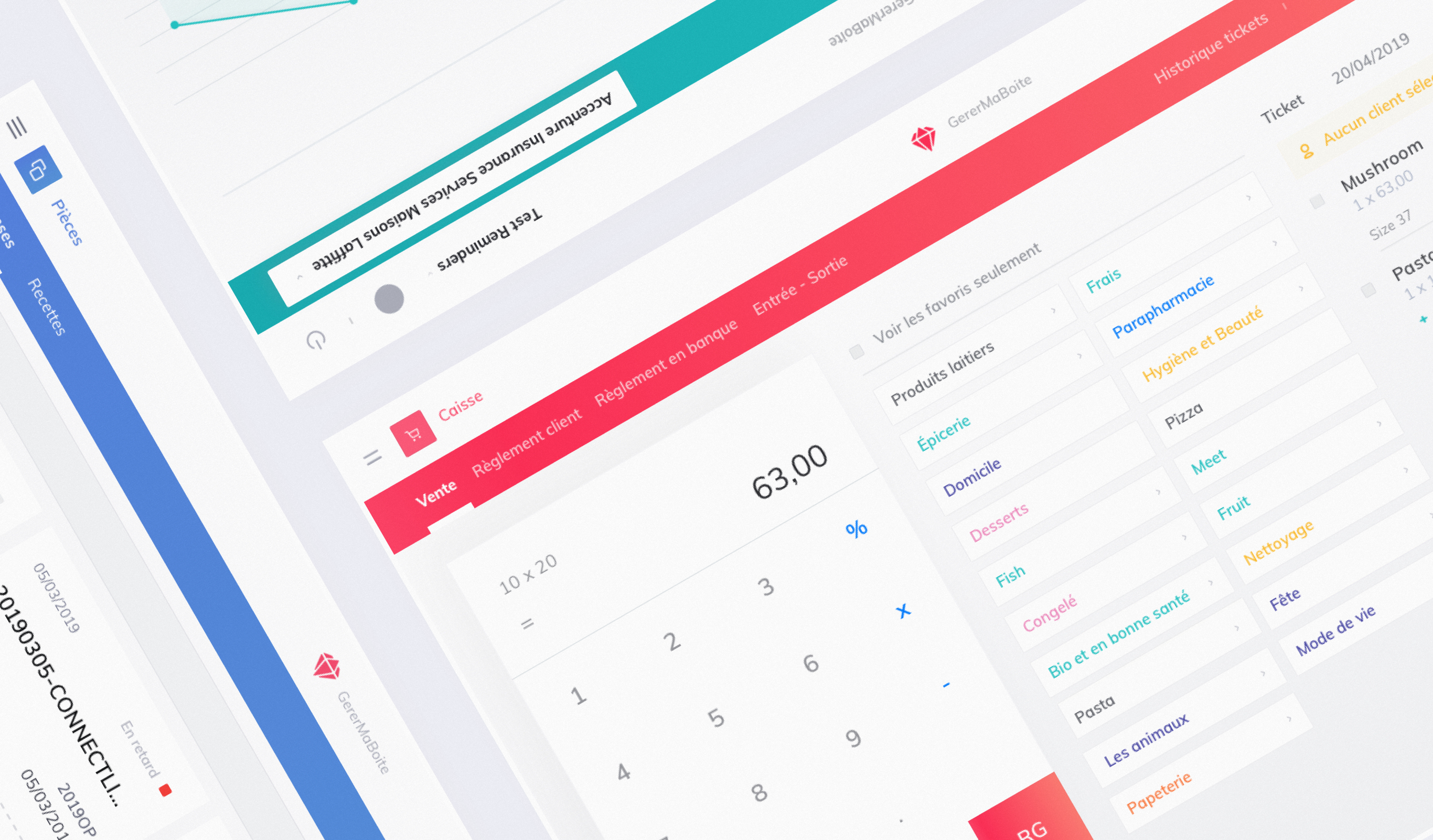
Brainstormed the core UI concept with the designer — encouraging focus, research, and lateral thinking. This process led to the dossier/folder metaphor: vertical tab navigation where each section represents a chapter in the business owner's workflow, with guided paths adapting to user profile.
Plain-language decisions, accounting logic intact
Bank reconciliation workflow.
Designed the bank reconciliation flow — the process where entrepreneurs match bank statement lines to invoices, expenses, or partial payments. The key decision: replacing accounting terminology with a card-based decision modal presenting four plain-language options ('I haven't registered the invoice,' 'It's a deposit or partial payment,' 'I have a registered invoice,' 'It's an exceptional operation'). Each option includes a short description so users understand the accounting implication without needing to know the terminology. The bank transaction stays visible on the right while the user works through the affectation on the left, and the remaining balance to reconcile updates live as items are assigned.
03 · In practice
The decision that made reconciliation legible without oversimplifying it.
Design rationale
Plain language over accounting terminology in bank reconciliation.
Entrepreneurs need to match bank statement lines to invoices — but most have no accounting background.
Standard accounting interfaces assume the user knows what 'rapprochement bancaire' means. These users don't.
The four possible actions ('I haven't registered the invoice', 'It's a deposit', etc.) can be expressed without a single accounting term.
Replaced accounting terminology with a card-based decision modal presenting four plain-language options, each with a short description of the accounting implication.
Entrepreneurs reconcile bank statements without guessing. The accounting logic stays intact underneath.
04 · Implementation
What was shaped in the design — mentorship, then direct design.
Design
What was shaped
- —Strategy and architecture guidance throughout the product lifecycle — brainstormed the core UI concept with the designer, leading to the dossier/folder metaphor and vertical tab navigation with guided paths per user profile.
- —Bank reconciliation workflow: card-based decision modal replacing accounting terminology with four plain-language options, split-screen layout with bank transaction context always visible, live-updating reconciliation balance, collapsible sections for progressive disclosure, and invoice matching view with search and filtering.
05 · Results & Metrics
A product that reached acquisition standard.
1
Workflow designed directly for the product designed by me.
4
Plain-language options replacing accounting terminology in reconciliation.
Formative
Mentorship stage — decisions shaped before they became entrenched.
06 · Trade-offs & Learnings
What advisory work at the formative stage taught.
— Working in an advisory and mentorship capacity at formative stages of a product — shaping decisions before they become entrenched — is a different kind of contribution than solo execution. The CEGID acquisition is the outcome: external validation that the product had reached a commercial standard a major enterprise software company was willing to put their name on.
Shape decisions while they're still cheap to change.
Mentorship at the formative stage — where direction has the most leverage.