Designed the central authentication experience used by every Securibox product — creating a single, consistent identity layer across the ecosystem.
- Product Design
01 · Context
Auth as the first impression of every product.
Every Securibox product required authentication. Without a central identity layer, users faced repeated sign-ups and inconsistent flows across the ecosystem, eroding trust.
Each product was rolling its own sign-in or had none — and the first interaction with any new product was a form that felt different from the last. In an ecosystem that needed to feel unified, the entry point was the one thing actively pulling it apart.
The identity question:
A central auth layer, inherited — not re-implemented — by every downstream product.
How do we make authentication feel like a trusted entry point to a unified platform, not a gate at every individual product?
02 · Key decisions
Decisions that made auth feel like a welcome.
OAuth and email as one consistent first step
Identity UX design across the ecosystem.
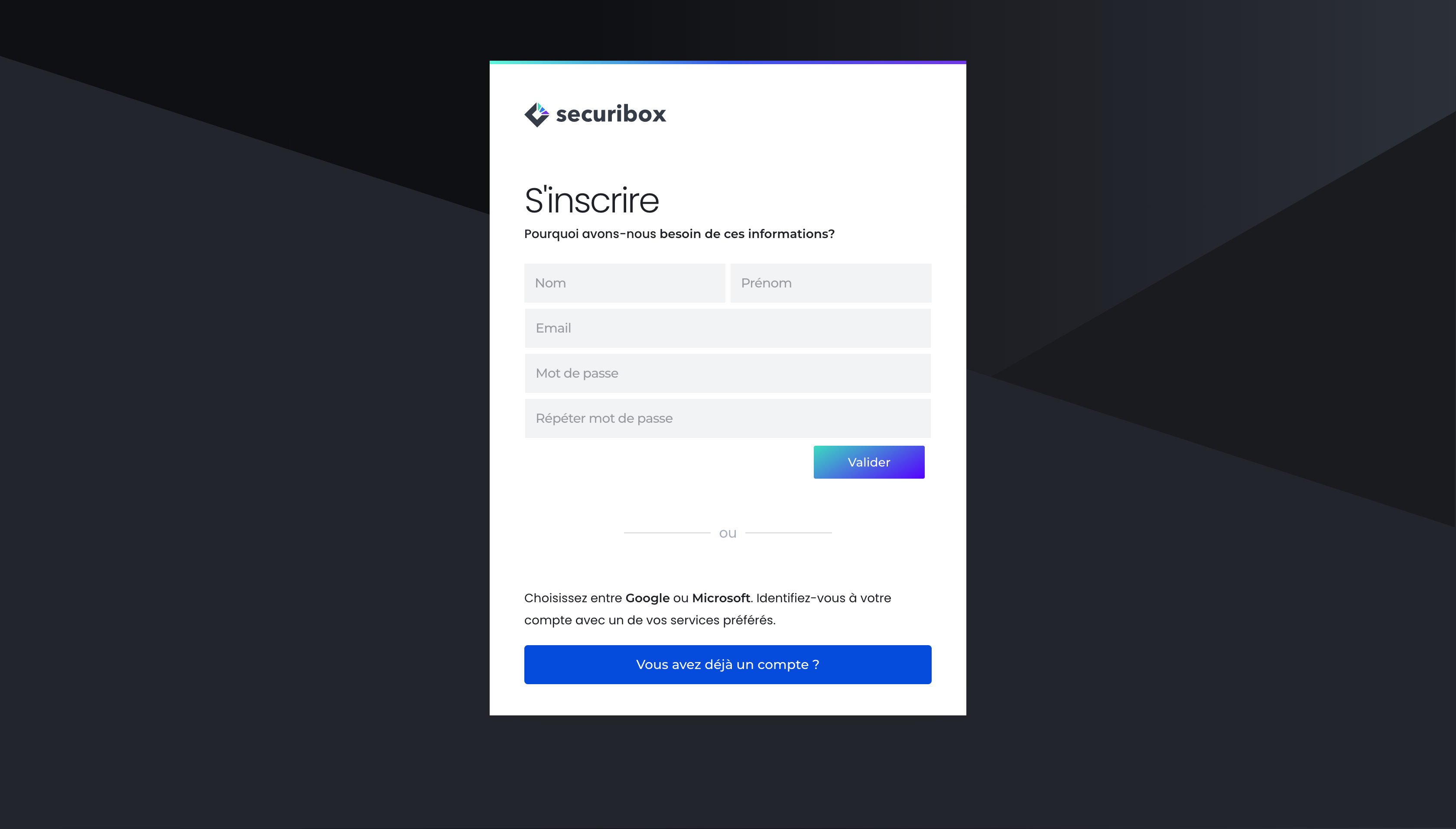
Designed OAuth flows (Google, Microsoft) and email registration flows for cross-product consistency — one shared first step into the Securibox ecosystem, regardless of which product the user is signing into.
Primitive · Shared auth shell
RGPD, WCAG, and enterprise review baked in
RGPD-compliant, accessibility-first auth.
Ensured auth forms and flows met RGPD standards — critical for enterprise clients — with controlled forms, explicit error surfaces, and WCAG-oriented focus order so outcomes are predictable in review.
Primitive reference
- AuthEntryOAuth (Google, Microsoft) and email rendered as one consistent first step.
- AuthErrorSurfaceExplicit error lines with WCAG-oriented focus order — predictable in enterprise review.
- RecoveryFlowPassword recovery and registration share the shell — not a separate product surface.
- Shared auth shellOne sign-in surface inherited by every downstream product — no per-product re-implementation.
- Compliance baked into the shellRGPD copy and consent patterns live at the shell level, inherited by every product on day one.
03 · In practice
The decision that set the trust baseline.
Systems thinking
Auth designed as a central layer, not an afterthought per product.
Every Securibox product required authentication — each was rolling its own or had none.
Inconsistent auth flows across products eroded trust and created repeated sign-up friction.
Making auth central to the design language ensures every product inherits the same trust baseline from day one.
Built one shared auth shell — OAuth, registration, recovery, WCAG focus order — inherited by all products.
Single identity across the ecosystem. Dependent products get consistent keyboard behaviour, error patterns, and trust cues for free.
04 · Implementation
Design for one shared auth shell.
Design
What was designed
- —OAuth (Google, Microsoft) and email registration paths as one consistent first step into the Securibox ecosystem.
- —Registration and recovery framed so authentication feels like a welcome entry, not a separate gate per product.
- —RGPD-aligned copy and consent patterns suited to enterprise expectations.
05 · Results & Metrics
One identity, inherited by every product.
1
Shared auth shell inherited by every Securibox product.
WCAG
Accessibility baseline across registration, sign-in, and recovery forms.
RGPD
Compliance baked into copy, consent, and error surfaces.
06 · Trade-offs & Learnings
What a shared auth layer taught.
— The Securibox ID auth layer became the first thing every new product inherits — the trust baseline that makes the ecosystem feel unified from the very first interaction.
One identity across the entire platform.
Auth that feels like a welcome, not a checkpoint.